Roofing built for how Marshall actually works
Marshall isn't a downtown with rows of storefronts - it's a stretch of rural-residential ground southwest of Spokane near Cheney, where the commercial buildings tend to be shops, equipment barns, ag storage, light-industrial spaces, and the occasional home-based business that has outgrown a garage. Each of those needs a different answer than a tract subdivision roof.
We size every project to the building and the budget, whether that means a single-ply membrane over a low-slope warehouse, a standing-seam metal roof on a pole building, or asphalt and synthetic underlayment on a steeper-pitched office. The goal is the same in each case: a roof that protects inventory, equipment, and revenue without demanding constant attention.
Wind off the prairie is the real test
The open ground around Marshall offers very little to slow the wind off the prairie before it reaches a rooftop. On flat and low-slope commercial roofs, that wind finds edges, seams, and fasteners - and a poorly detailed perimeter is where most failures start.
We pay close attention to the parts owners never see: properly fastened edge metal, mechanically attached or fully adhered membranes rated for the exposure, and reinforced details at corners and curbs. On metal systems, we use concealed-fastener panels and clips that let the roof move without backing screws out over time. The result is an envelope that handles gusts instead of peeling at the first hard blow.
Snow load, freeze-thaw, and standing water
Inland Northwest winters stack heavy snow on commercial roofs for weeks at a stretch, and the freeze-thaw swing that follows works its way into any weak seam. Low-slope buildings face an added problem: ponding water that never fully drains, slowly degrading the membrane and overloading the structure.
- Drainage first. We assess slope, drains, and scuppers so meltwater leaves the roof instead of pooling.
- Ice-dam defense. Proper insulation and ventilation reduce the warm spots that drive snowmelt and refreeze at the eaves.
- Cold-weather details. Flashings and terminations are built to flex through repeated freeze-thaw cycles without cracking.
Less downtime, more uptime
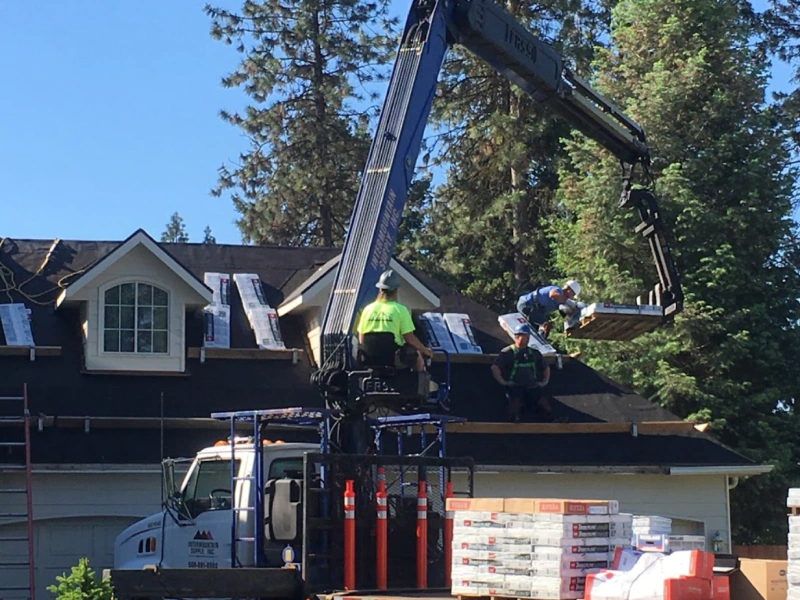
A commercial reroof is disruptive when it's run badly. We schedule phased tear-offs and installs so a working building keeps working - staging materials away from loading areas, sequencing sections so part of the roof is always weather-tight, and keeping the site clean with magnetic sweeps for fasteners that could flatten a delivery truck's tire.
For owners along Marshall Rd who can't simply shut down for a week, that planning is often the difference between a roof project and a roofing emergency.
Maintenance and repair, not just replacement
Not every commercial roof needs to come off. Many of the buildings we inspect around Marshall have years of service left once the failure points are corrected - a split seam, a failed pipe boot, oxidized edge metal, or a clogged drain. We're upfront about which roofs are repair candidates and which are past saving.
For roofs still in good shape, scheduled maintenance catches small problems before they reach the insulation or the deck. If you also handle homes or rentals in the area, our residential roofing in Marshall covers those structures with the same standards.
A contractor your business can stand behind
DG Contracting has been a family-owned company since 2013, licensed and insured in both Washington and Idaho, and one of the small group of GAF Master Elite contractors - a status held by roughly the top 2 to 3 percent of roofers nationwide. For a commercial owner, that means manufacturer-backed warranty options and a crew that has to meet a measurable bar to keep the certification.
Our work is backed by a 15-25 year workmanship warranty, with GAF Golden Pledge coverage available on qualifying systems. Estimates are free, financing is flexible, and you'll talk to people who answer for the work long after the last panel goes down.