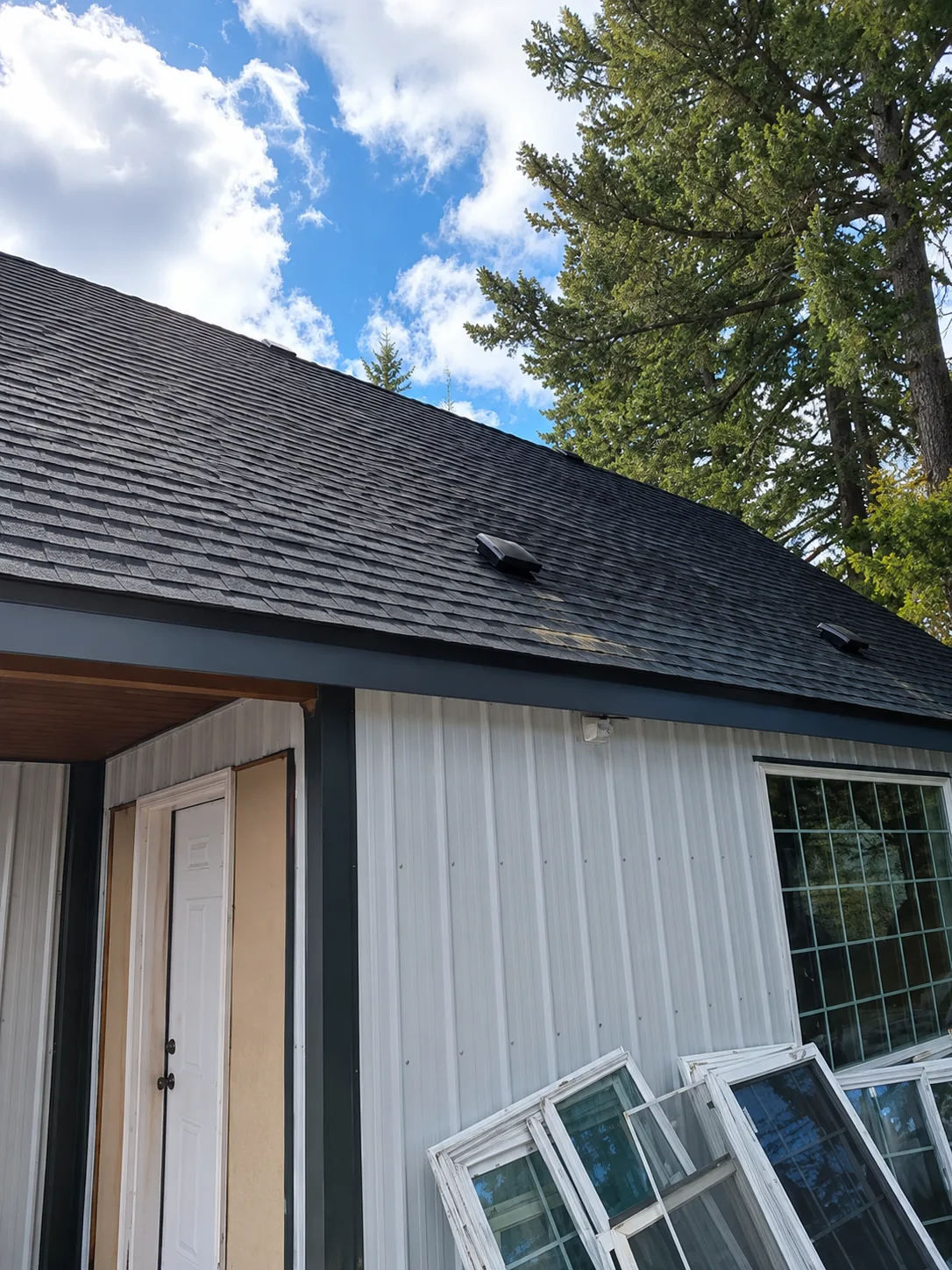
Your shingles are not your last line of defense
When most homeowners picture a roof, they picture the shingles. But the visible surface is really a shield against sun, wind, and impact, not a watertight membrane. Wind-driven rain, melting snow, and ice can all push water past or under shingles, especially as they age and as fasteners flex through thousands of freeze-thaw cycles.
What actually keeps that water out of your attic and walls is the layer underneath: the underlayment, and in critical zones, a self-sealing ice-and-water shield. These layers are hidden, inexpensive relative to the whole job, and frequently the difference between a roof that quietly performs for decades and one that leaks at the worst possible time. In the Inland Northwest, where a roof can sit under a foot of snow for weeks, that hidden layer earns its keep.
What underlayment is and what it does
Underlayment is the continuous water-resistant sheet installed over your roof deck (the plywood or OSB) before the shingles go on. It serves several jobs at once:
- Secondary water barrier. If water gets past the shingles, the underlayment carries it down and off the roof rather than into the deck.
- Deck protection during the build. It keeps the bare deck dry between tear-off and the final shingle course, which matters during unpredictable spring and fall weather.
- A smoother, more uniform surface for the shingles to lie on, reducing telegraphing of small deck imperfections.
There are two broad families. Felt (the traditional asphalt-saturated #15 or #30 "tar paper") is cheap and still code-acceptable, but it wrinkles when it gets wet, tears more easily, and degrades faster in sun. Synthetic underlayment is a woven polypropylene or polyester sheet that is lighter, far stronger, lies flatter, resists UV longer if exposed, and is much safer to walk on. For a long-term roof in our climate, synthetic is the better foundation, and it's what we install as standard on a roof replacement.
Ice-and-water shield: the part that matters most up here
Ice-and-water shield is a different animal. It's a rubberized-asphalt membrane with an adhesive back that bonds directly to the deck and self-seals around nails and fasteners. That self-sealing property is the whole point: even when shingle nails penetrate it, the membrane grips the shank and closes off the hole, so water that backs up under the shingles still can't reach the wood.
This is the single most important detail for Spokane, Spokane Valley, Coeur d'Alene, and the rest of North Idaho, because of one specific problem: ice dams. When attic heat melts snow on the upper roof and that meltwater refreezes at the cold eaves, it builds a ridge of ice. Water pools behind the dam and is forced uphill, underneath the shingles, by capillary action and sheer volume. Ordinary underlayment slows it; ice-and-water shield stops it.
Where ice-and-water shield belongs on your roof
You don't need to cover the entire deck with membrane (that can trap moisture and is rarely worth the cost). Instead, it goes in the vulnerable zones:
- Eaves. Code and good practice call for membrane extending from the edge to at least 24 inches inside the warm wall line. In heavy-snow areas many roofers go further, often two courses, to stay well ahead of where ice dams form.
- Valleys. Where two roof planes meet, water concentrates and snow lingers. Valleys get a full run of membrane.
- Around penetrations. Chimneys, skylights, plumbing vents, and dormers are classic leak points and benefit from membrane flashing.
- Low-slope sections and roof-to-wall transitions, where water moves slowly and is more likely to find a way in.
Local snow load and your roof's pitch should drive how far the eave membrane reaches. A steep roof in Colbert sheds snow differently than a low-slope section over a Spokane Valley addition, and the underlayment plan should reflect that rather than following a one-size template.
Underlayment can't fix a ventilation problem
Here's the part many homeowners miss: ice-and-water shield treats the symptom, not the cause. Ice dams form because heat is escaping into the attic and melting snow unevenly. The real fixes are adequate attic insulation and balanced intake-and-exhaust ventilation that keeps the roof deck close to outdoor temperature so snow melts evenly (or not at all) instead of refreezing at the eaves.
A quality roof system treats these together: membrane as the insurance policy in the zones where water concentrates, and proper ventilation so you rarely have to rely on it. When we scope a project, we look at the attic, the ventilation, and the existing leak history, not just the shingles. If your home has had recurring ice dams or eave staining, that's a signal the system needs more than new shingles.
Why this is hard to inspect after the fact
The frustrating reality is that once the shingles are on, you cannot see whether the right underlayment and membrane were installed, or whether they were lapped, sealed, and run to the proper distances. This is exactly where corner-cutting hides, because it's invisible until the first hard winter exposes it.
That's why the manufacturer and installer matter as much as the materials. As a GAF Master Elite contractor (a designation held by only the top 2 to 3 percent of roofers in North America), DG Contracting installs full GAF systems to spec, which is what makes homes eligible for the GAF Golden Pledge coverage of 25 to 50 years on materials, on top of our own 15-25 year workmanship warranty. The warranty is only as good as the layers you can't see, so the documentation and verified installation are part of what you're paying for.
What a good underlayment spec looks like in the Inland Northwest
If you're comparing roofing quotes, ask each contractor to put the hidden layers in writing. A solid spec for our climate generally includes:
- Full synthetic underlayment across the field of the roof, not felt.
- Ice-and-water shield at all eaves, run at least 24 inches past the interior wall line, more on low-slope or high-snow areas.
- Membrane in every valley and around all penetrations and wall transitions.
- A ventilation and insulation review as part of the estimate, not an afterthought.
If a bid doesn't mention any of this, that's worth a direct question, because it's where price differences between two otherwise similar quotes often come from. DG Contracting is licensed and insured in both Washington and Idaho, and we'll walk through exactly what's going on your deck before any shingles are nailed down. Request a free estimate and we'll lay out the full system for your home, eaves to ridge.