Where the water goes is where the damage starts
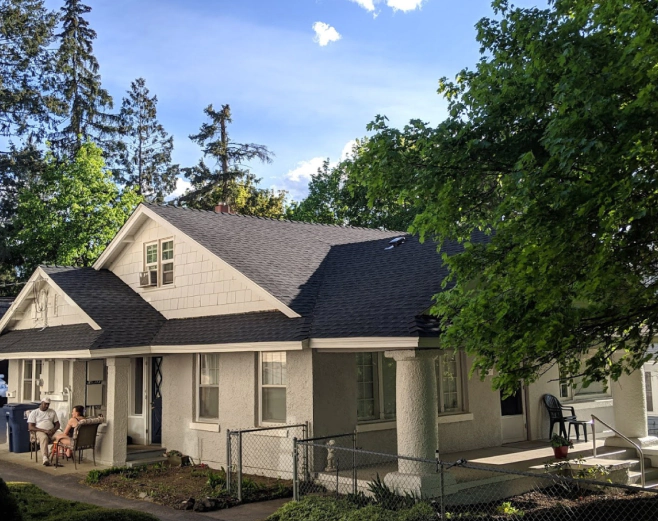
Stand under the eave of one of the grand homes near Coeur d'Alene Park during a hard spring rain and you can watch the problem unfold. A failed or undersized gutter doesn't just overflow, it concentrates the entire surface of a tall roof into a single sheeting curtain that drives straight down against the foundation wall and into the backfill.
Over a few seasons that repeated soaking does two things at once. It washes fine soil out from under and around the footing, leaving voids that let the structure settle unevenly. And it keeps the perimeter saturated, so every freeze-thaw cycle of an Inland Northwest winter pries at brick, mortar and basement walls with the slow leverage of expanding ice. The gutter on the roofline is, in practice, the first line of defense for everything below grade.
Why erosion hits Browne's Addition harder than newer neighborhoods
The historic brick mansions here were built long before footing drains and waterproof membranes were standard. Many sit on rubble or unreinforced masonry foundations that tolerate moving water poorly once it starts carrying soil with it. A newer home can shrug off a sloppy downspout for years; a turn-of-the-century foundation cannot.
The steep century-old roofs make it worse. A steep, large roof delivers a lot of water fast, so the gutter and downspout system has to genuinely keep up under peak flow. When it can't, the overflow always finds the same low spot in the yard, and that low spot is usually right where you least want standing water, hard against the house.
What proper gutters do for the soil around your home
The job of a gutter system on these properties is simple to state and easy to get wrong: capture all of the roof water, and carry it far enough from the building that it can't undermine the foundation. We size gutters and downspouts to the roof area they actually serve, not to a one-size default, then aim discharge well past the backfill zone with extensions or buried lines as the lot allows.
- Correct slope and capacity so a steep roof's peak runoff doesn't sheet over the front edge.
- Enough downspouts to split the volume instead of overwhelming a single corner.
- Discharge placed away from the footing so water drains across grade rather than pooling against the wall.
- Sealed seams and solid hangers that hold through snow load and ice.
Soffit and fascia: the part nobody sees until it fails
Fascia is the board your gutter hangs from, and soffit is the underside of the eave. On older Browne's Addition homes both are often original wood, and once water has been overflowing a tired gutter for a season or two, that wood is the first casualty. Soft, rotted fascia can't hold a gutter steady, so the system sags, the slope goes wrong, and the overflow problem feeds itself, sending even more water to the ground.
We repair or replace damaged fascia and soffit as part of the work, matching profiles that suit the historic character of the block, and we make sure the soffit stays properly vented so attic moisture has a way out. A solid, dry eave is what lets a new gutter actually stay put and do its job for decades.
A whole-system look before we quote a number
Because the gutters, the eaves and the soil around the foundation are one connected system, we don't bid a gutter run in isolation. We walk the full roofline, check the fascia for rot, look at where water is currently landing, and note any settling or staining that points to past erosion. That way the fix addresses the cause, not just the symptom.
We're a family-owned GAF Master Elite contractor working throughout the Inland Northwest, and gutter and eave work pairs naturally with our roof replacement projects, which include a 15-25 year workmanship warranty. Whether you need a full system or targeted repairs, every estimate is free.
Built for Inland Northwest winters, not just rain
Heavy snow, ice dams and the relentless freeze-thaw swing are the real test for any eave system around here. Gutters have to handle the slow drip of a melting snowpack as well as a downpour, and they have to do it without tearing loose under the weight of ice. Our installs are anchored and sealed for that load.
Everything we do is backed by a 15-25 year workmanship warranty, and we're licensed and insured in both Washington and Idaho. The point of all of it is the same thing it has always been on these old streets: keep the water moving away from the house, so the foundation stays where the builders put it a hundred years ago.