
Why low-slope sections fail first around Rockwood Blvd
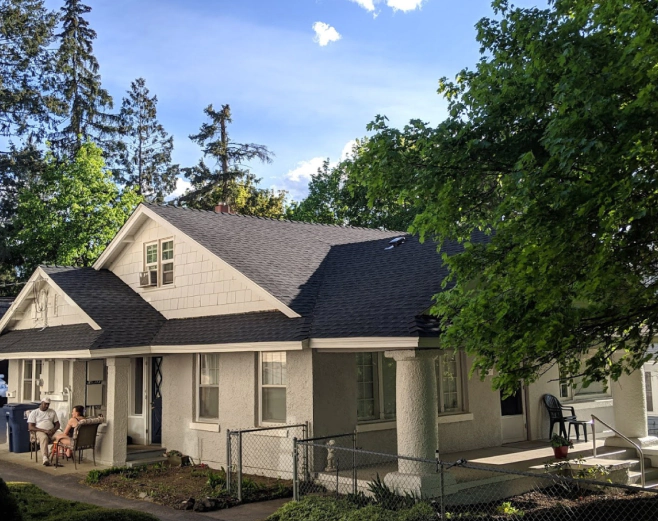
Many of the large historic estate homes near Rockwood Blvd on the South Hill were built with a steep main roof and one or two flat or near-flat areas - a sunroom, a bay over the entry, a flat-roofed wing added decades after the original construction. Water drains off a steep pitch in seconds; on a flat deck it sits, pools, and finds every seam. When the original built-up or rolled roofing dries out and the laps open, the leak rarely shows up directly below. It tracks along framing and surfaces in a hallway or closet two rooms away.
That is why we look at the whole low-slope system - drainage path, slope to the scuppers or drains, parapet flashings, and how the flat section ties into the adjacent steep roof - rather than just patching the wet spot.
What TPO brings to a South Hill flat roof
TPO (thermoplastic polyolefin) is a single-ply membrane that we heat-weld seam to seam, so the finished surface is effectively one continuous sheet instead of dozens of overlapped, glued laps. That matters here for a few reasons:
- Ponding tolerance. Older flat decks rarely drain perfectly. A welded membrane holds water far better than aged rolled roofing.
- Reflectivity. The bright white surface sheds summer heat, which helps on the unshaded flat areas while the rest of the property sits under cover.
- Cold-weather durability. TPO stays flexible through the Inland Northwest freeze-thaw cycle instead of going brittle and cracking.
For homeowners who want a different look or are matching a specific assembly, we also install PVC and modified-bitumen systems. The right membrane depends on the deck, the slope, and the detailing - not a one-size answer.
Tree canopy, debris, and standing water
Rockwood's heavy tree canopy is part of what makes the neighborhood feel the way it does, but it is hard on flat roofs. Needles, leaves, and seed litter collect in the low spots and at the drains far faster than they would on a steep pitch. Once a drain or scupper clogs, a flat section can hold an inch or more of water through a rain event, and that load combined with organic debris breaks down old membranes quickly.
When we install a TPO roof on a tree-shaded property, we pay close attention to drainage - clean inlets, proper crickets where needed, and flashing that keeps debris from damming at the edges. We will also tell you honestly which sections need clearing once or twice a year so the membrane lasts its full service life.
Snow load and ice on flat decks
Steep roofs shed snow. Flat and low-slope decks do not - they hold it, and the weight sits on the membrane and framing until it melts. On the large historic estate homes in this part of Spokane, that standing snow refreezes at the edges and around penetrations, working open any weak seam. A heat-welded TPO surface with properly terminated edges and flashed penetrations gives that snow nowhere to get in. We detail every pipe boot, curb, and parapet so the freeze-thaw cycle does not pry the system apart at its most vulnerable points.
How we approach the work
We start with a free, no-pressure inspection of the low-slope area and how it connects to the rest of the roof. If the deck below is sound, a new single-ply membrane often goes over a clean substrate; if there is rot from years of ponding, we address the decking first so the new roof has something solid to bond to. Every flat-roof project gets the same edge, drain, and penetration detailing that decides whether a membrane lasts ten years or thirty.
DG Contracting is a family-owned, GAF Master Elite contractor licensed and insured in Washington and Idaho, and our flat-roof work carries the same 15-25 year workmanship warranty we put behind our shingle installations. If your project also includes a steep section, ask about our roof replacement options so the whole roof is handled together.
Repair, recover, or full replacement
Not every flat roof needs to be torn off. We will give you a straight read on which path fits:
- Repair when the membrane is generally sound and the problem is isolated to a seam, a boot, or a flashing.
- Recover when the field is failing but the deck is dry and structurally fine - a new membrane over the existing assembly.
- Full replacement when there is trapped moisture or deck rot that has to come out.
You get the recommendation, the reasoning, and a written estimate. No upsell to a tear-off you do not need.