Chimney flashing is the first thing we open up
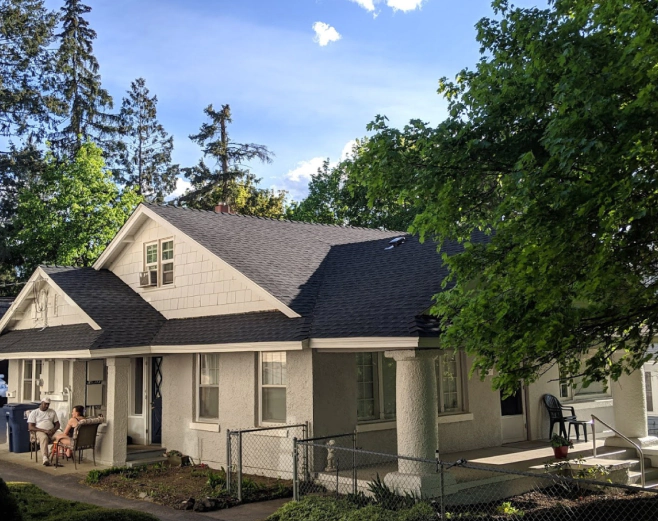
South Hill has a lot of brick-chimney houses from an era when flashing was bedded in mortar and roof cement rather than counter-flashed into a cut reglet. Decades of freeze-thaw work the mortar joints loose, the step flashing corrodes, and water tracks down the chimney chase well before anything shows indoors.
When we get a chimney-leak call in Lincoln Heights or near Comstock, we pull the shingles back along the chimney and inspect every plane: the front apron, the woven step flashing up both sides, the back pan or cricket, and the counter-flashing let into the masonry. A smear of sealant over a rusted joint is not a repair, it is a countdown. We rebuild the assembly with new metal and correct laps so it sheds water instead of trapping it.
Why valleys fail on steep-pitch roofs
The historic steep-pitch homes on the Hill push a large volume of runoff and snowmelt through their valleys, and two failures show up over and over:
- Open-metal valleys where the W-channel has rusted through or the center hem has flattened, letting water slip sideways under the shingles.
- Closed-cut valleys reroofed without a membrane underneath, so the seam leans entirely on shingle overlap.
On a steep pitch the water moves fast and the margin is thin. We strip the valley, run self-adhered ice-and-water membrane the full length, and reset the planes so they drain cleanly past each other.
Wall, dormer, and kick-out transitions
Many South Hill houses carry dormers, rear additions, and lower-roof-to-wall junctions that have been re-sided over the years. Where a roof butts against a wall, the kick-out flashing at the bottom of the run is the piece most often missing, and its absence sends water straight in behind the siding. We add or rebuild kick-outs, re-step the wall flashing, and tie it into the housewrap so the transition is genuinely weathertight rather than just covered.
What hard winters do to aging detailing
When snow load sits on a steep roof and the lower edge refreezes, standing water hunts for the weakest joint, and on these homes that is almost always a tired flashing detail rather than the shingles themselves. We pair flashing repairs with eave protection and a ventilation check so the same spot does not refreeze and reopen the next cold snap. If the deck or fascia underneath has already gone soft, we show you the wood and tell you straight.
Repair, or time to reroof?
Some South Hill roofs have one worn flashing detail on an otherwise sound roof, which is a clean, contained repair. Others have brittle shingles, several failing transitions, and old patches stacked on top of each other, where laying good metal under bad shingles is throwing money away. We give you the honest read either direction. If a full replacement is the smarter call, ask about our roof replacement in Spokane, the 15-25 year workmanship warranty, the GAF Golden Pledge coverage, and a 15-25 year workmanship warranty with a new roof.
Local, licensed, and easy to verify
DG Contracting is a family-owned company founded in 2013, based in Colbert and working across the Inland Northwest. We are GAF Master Elite certified, a credential held by only the top 2 to 3 percent of roofers, fully licensed and insured in Washington and Idaho, and carry a 5.0 rating across 303 Google reviews. Estimates are free and financing is flexible. Call (509) 209-1894.