Why the Rubber Gives Out Before the Roof Does
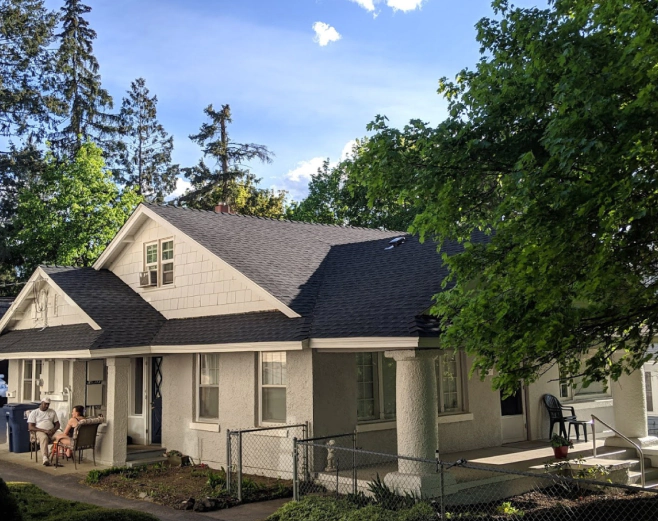
Comstock sits in the heart of the South Hill, and the established homes around Manito Park were largely built and re-roofed long enough ago that their plumbing-vent boots have simply aged out. The shingles can still have years of life left while the soft rubber collar wrapped around each vent pipe has gone brittle, split, and pulled away from the steel.
The cause is almost always the same: UV and the freeze-thaw swing. Summer sun bakes the exposed rubber until it hardens, then every overnight freeze and afternoon thaw flexes that hardened collar until it cracks right at the pipe. Once it splits, water runs straight down the outside of the pipe, into the attic, and along a rafter long before it ever reaches the drywall you can see.
How a Failed Boot Fools You
This is the leak that gets misdiagnosed more than any other we see in Comstock. Homeowners assume a stain on a bedroom ceiling means a shingle problem directly above it, but water from a bad vent boot travels. It can surface six or eight feet from the actual pipe.
Telltale signs we look for:
- A round, halo-shaped stain rather than a downhill streak
- Staining that appears only after a hard freeze or heavy rain, then dries up
- A faint musty smell in the attic near a vent stack
- A cracked or curled lip on the rubber collar once we are on the roof
Because the failure is small and intermittent, it is easy to ignore until the sheathing around the pipe goes soft. Catching it early is the whole difference between a quick repair and a tear-out.
Vent Seals: The Quieter Twin
Pipe boots get most of the blame, but the metal flashing around furnace flues, bath-fan vents, and attic exhaust caps fails the same way. The bead of sealant tying those caps to the shingles dries, shrinks, and lifts, and the fasteners back out a hair with every freeze cycle.
On Comstock's mature tree-lined streets, the big shade canopies that make the neighborhood beautiful also keep these roof penetrations damp longer after every storm, so the sealant and surrounding shingles weather faster than a sun-baked roof would. We re-seal, re-flash, and where needed replace the cap entirely so the joint sheds water instead of trapping it.
What Our Repair Actually Includes
We do not just smear caulk over a cracked boot and call it done. A proper repair on these older South Hill roofs means:
- Lifting the surrounding shingles and removing the failed boot or seal cleanly
- Installing a new boot with a UV-resistant collar, or an all-metal storm collar where the pipe sees full sun
- Checking the sheathing underneath and replacing any that has gone soft
- Re-bedding the flashing and weaving the shingles back so the repair is watertight and invisible from the street
Every repair is backed by our 15-25 year workmanship warranty, the same standard we hold on a full replacement. If an inspection shows the damage runs deeper than a patch, our roof replacement work carries the GAF Golden Pledge as well.
A Local Crew That Knows These Roofs
DG Contracting has been a family-owned, GAF Master Elite contractor since 2013, licensed and insured in both Washington and Idaho. We work the South Hill constantly, so we know how Comstock's established homes are built and exactly where their penetrations tend to fail.
That experience matters most on a repair, where the goal is to fix the real leak path the first time rather than chase a stain. Our 5.0 rating across 303 Google reviews comes largely from getting these small-but-sneaky leaks right. Estimates are always free, financing is flexible, and there is no pressure to replace a roof that only needs a boot. Call (509) 209-1894 to get on the schedule.