Why Wind Lifts Shingles in NW Spokane
Shadle Park sits on the gently rolling, exposed ground of NW Spokane, where there is little to slow a gusty afternoon before it reaches your eaves. Wind does not have to be a named storm to do damage. A steady 40 to 50 mph push gets under the leading edge of a shingle, breaks the heat seal that bonds it to the course below, and folds it back. Once that seal lets go, the shingle never lies flat again, even after the wind dies down.
From the ground a wind-lifted shingle can look fine, then catch the light wrong and you notice it standing slightly proud of the rest. The real trouble is the row of exposed nails and the underlayment now taking direct sun and rain. We see this most on the west- and south-facing slopes that take the brunt of the prevailing wind.
Wind-Lifted vs. Truly Missing Shingles
There are two failures we chase on these calls, and they are repaired differently:
- Wind-lifted shingles are still attached but no longer sealed. They flap, let water track sideways under the course, and tear free in the next gust. Caught early, many can be re-nailed and hand-sealed back down.
- Missing shingles have already blown off, leaving exposed felt or, worse, bare deck. These need replacement tabs woven in and re-flashed where needed so water cannot get behind the patch.
On older roofs the surrounding shingles have lost flexibility, so a careless repair cracks three good shingles trying to lift one. That is why hand technique matters more than speed here.
Mid-Century Ramblers Near Wellesley & Ash
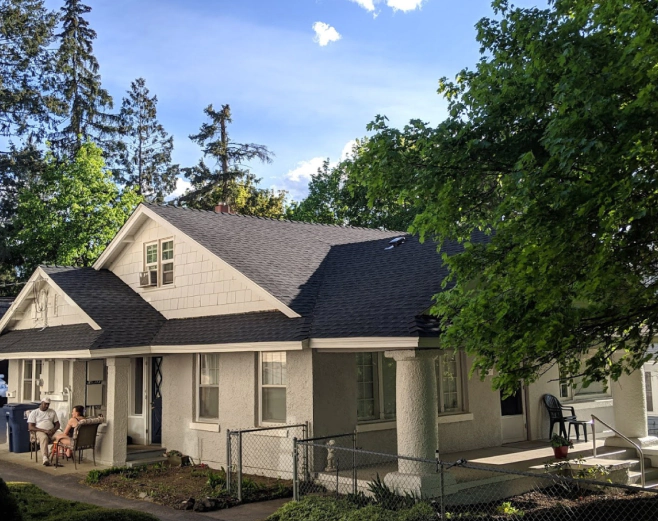
A lot of Shadle Park is classic mid-century ramblers with long, low-slope runs and wide eaves, the kind of homes you will find all through the neighborhoods around Wellesley & Ash. Those broad, shallow slopes are exactly the shape wind likes to get under, and many still carry a second or third layer of shingles from decades of overlays.
Low slope changes the repair. Water moves slowly off a shallow roof, so a wind-damaged section that would shed fine on a steep roof can pond and back up here. We adjust our patch detailing, and sometimes the underlayment beneath it, to match the pitch instead of treating every roof the same.
How We Match Old Shingles
The fear on a partial repair is a bright new patch glaring against a faded roof. We pull a sample, identify the line and color, and source the closest current match. On discontinued products we weather-match from a nearby supplier, or, when the damage zone is large enough, recommend re-shingling a full slope so the seams fall on natural break lines instead of mid-field.
We are GAF Master Elite certified, which gives us access to GAF's full color range and the training to blend a repair so it reads as one roof, not a quilt. Where a repair is not enough, we will tell you plainly and walk you through full roof replacement options.
What a Shadle Park Repair Visit Looks Like
We start at the eaves and work up, looking for the lifted tabs you cannot see from the driveway and checking that the seal strip is actually bonded and not just resting in place. We inspect valleys, the flashing around your chimney and vents, and the decking under any soft spot. Then you get a straight answer - re-seal, patch, or replace - with photos of what we found.
DG Contracting has been a family-owned, licensed and insured crew (WA and ID) since 2013, with a 5.0 rating across 288 Google reviews. Repairs are backed by our 15-25 year workmanship warranty, and every visit starts with a free estimate. Reach us at (509) 209-1894.
Don't Wait for the Next Gust
A single lifted shingle is a cheap fix. The same shingle left through one more windy week becomes a torn-off section, a soaked deck, and a stain on the ceiling inside. Inland Northwest weather does not give you a long grace period between the wind and the freeze-thaw that follows.
If you have found shingle pieces in the yard, see daylight gaps along a ridge, or just want a roof checked before fall, call us. We will get a Shadle Park roof buttoned down before the next system rolls through.